|
Trench Hexagons |
| 2025-12-24 |
Trench Hexagons
Modular terrain for Trench+Crusade in the making.
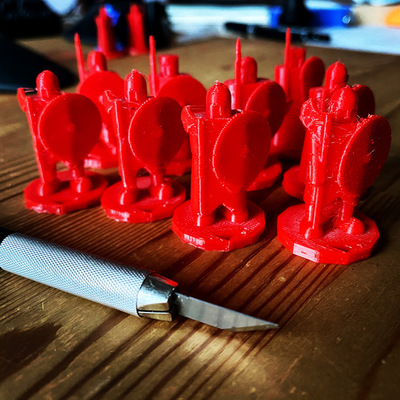
My friends are preparing and painting their warbands. I am making terrain, I asked a friend to print and paint a vanilla Heretic warband. He is a demanding and talented painter and I have no experience in painting miniatures, terrain and geometry are what I prefer. I am looking forward to see the result of his work and field the warband.
My friends chose the Sultanate, the Red Brigade, and the Trench Pilgrim. We needed a bad guy, so I chose the Heretics, the lesser evil?
Why the hexagons ? Because, well, hex and counters, ... Not entirely. Another reason was the easy "traversing" it offered. Trenches are traversed because that limits the effect of artillery blasts and it limits the range of direct fire along the trench. Zig zagging.
I did not want to go into "Wedding Cake Crusade", I wanted to go "Trench+Crusade". Granted, the scenarios presented in the rules are all except one set in landscapes devoid of tranches. The boards seen in the FB group for the game are all very complex and vertical. Anything that blocks the line of sight and makes for small tactical fun. I am going for something flatter, something where the top of your trench doesn't face a wall.
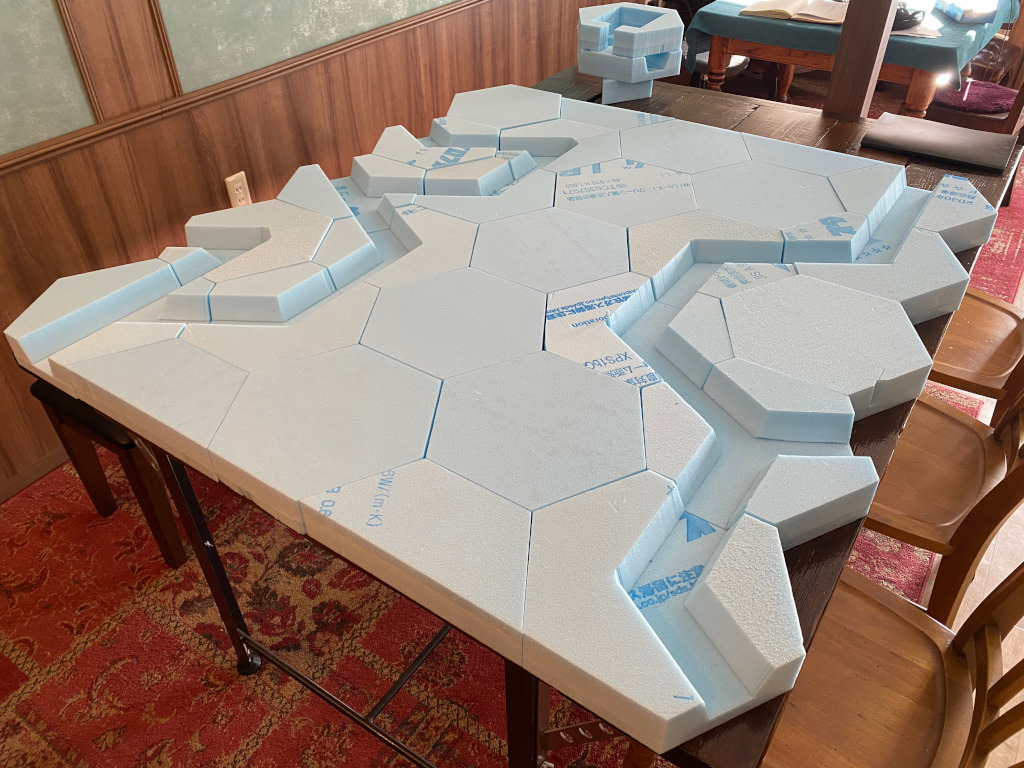
Something bland can be made richer with scatter terrain and random buildings. From the flattness of the fields of Flanders to the three-dimensional maze of Mordheim, I trust my modules can deliver.
The post-trench building period will probaly devolve into studying western european cityscapes and make hexagons for a western 1915 Stalingrad. That'll do for the Mordheim ADN in Trench+Crusade.
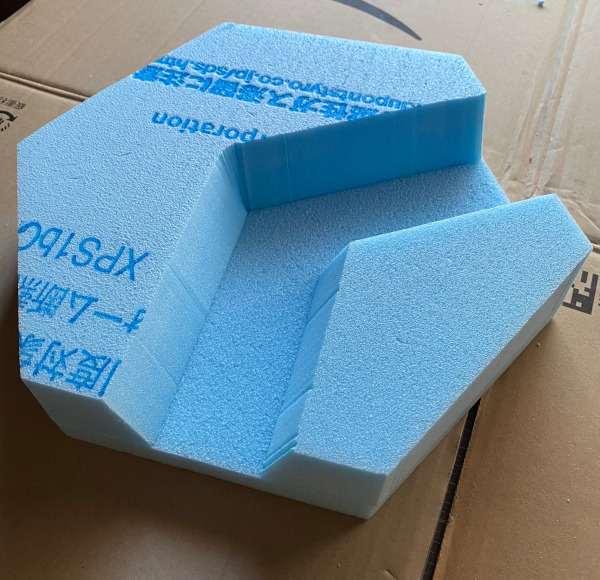
The XPS foam at my local DIY store was cheap. I even bought pieces that were a bit damaged and heavily discounted. I bought 1.5 cm sheets as a base layer and 4 cm sheets for the feet of the trench to the top of the trench layer.
I chose an inclination angle (1.5 cm horizontally for 4 cm vertically), a trench bottom width (5 cm, roughly almost two "normie" miniature bases), and started cutting the XPS foam.
Two types of hexagons emerged. Trench hexagons and plain hexagons. There will be half-hexagons as well, but that's lower priority.
Trench hexagons contain a section of trench and are single sided, while plain hexagons are double-sided. A flat side and a depressed / craterized side. I experimented with craters made bit hammer hits, by brush cleaner liquid corrosion, heat gun attack, and lastly, with the impact of a 24 kg russian kettlebell 1 meter fall.
The XPS cutting was easy thanks to a hot cutter table. I tried to be efficient, but I'm still left with two full Ikea bags of XPS offcuts, it will be useful for scatter terrain and other fancy trench+crusady stuff. The important thing was to prepare jigs for the hexagons and half-hexagons, and jigs for the "negative trenches". I also had a jig to set the trench angle on the hot cutter table.
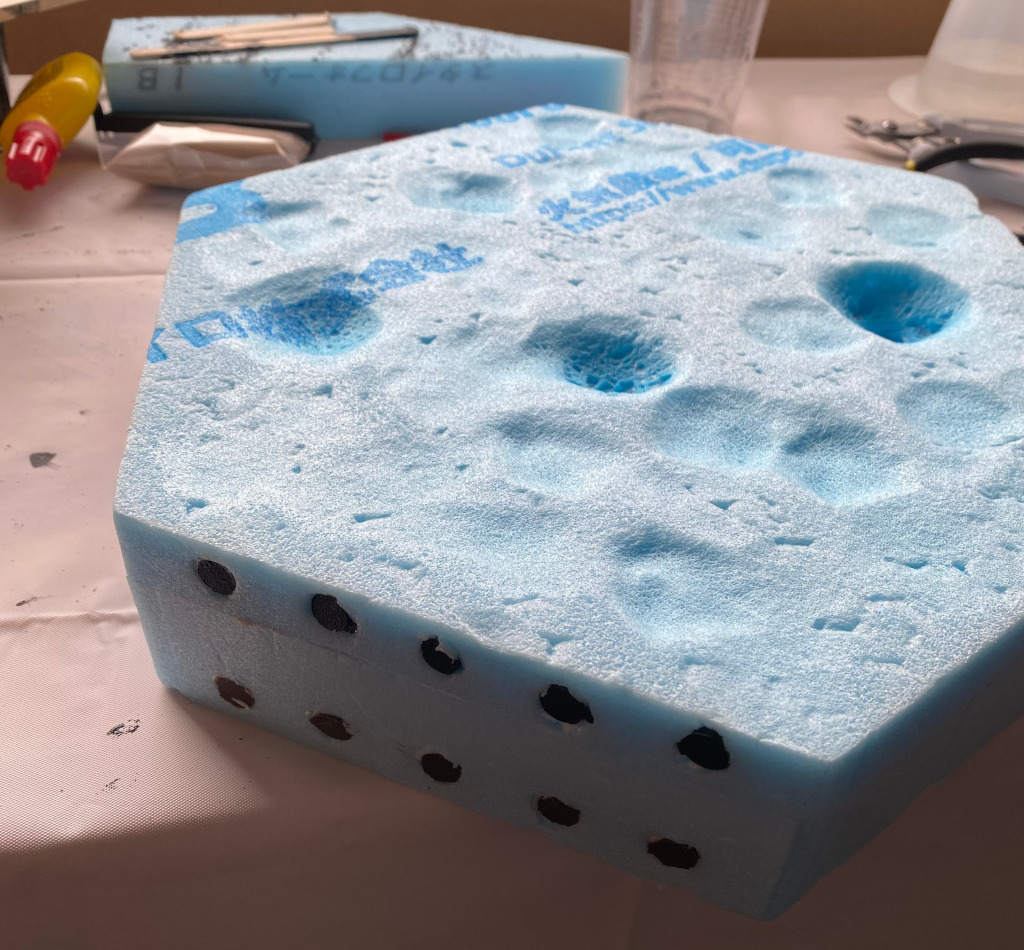
The six sides of each hexagons have been implanted with up to 10 small plastic boxes each containing a 5 mm diameter magnet ball. It is sufficient to help the hexagons sticking together.
The magnet boxes are printed on my FDM printer. Each has box has 3 anti-rotation fins (small wings) that prevent them exiting the foam once plugged, along with PVA glue. I choose ball magnets in boxes to let the magnets decide on their own what polarity they present.
Trench+Crusade advocates four feet by four feet terrains. I chose 16 cm (6 feet) for the side of an hexagon, so a table requires 25 hexagons (plus four half-hexagons).
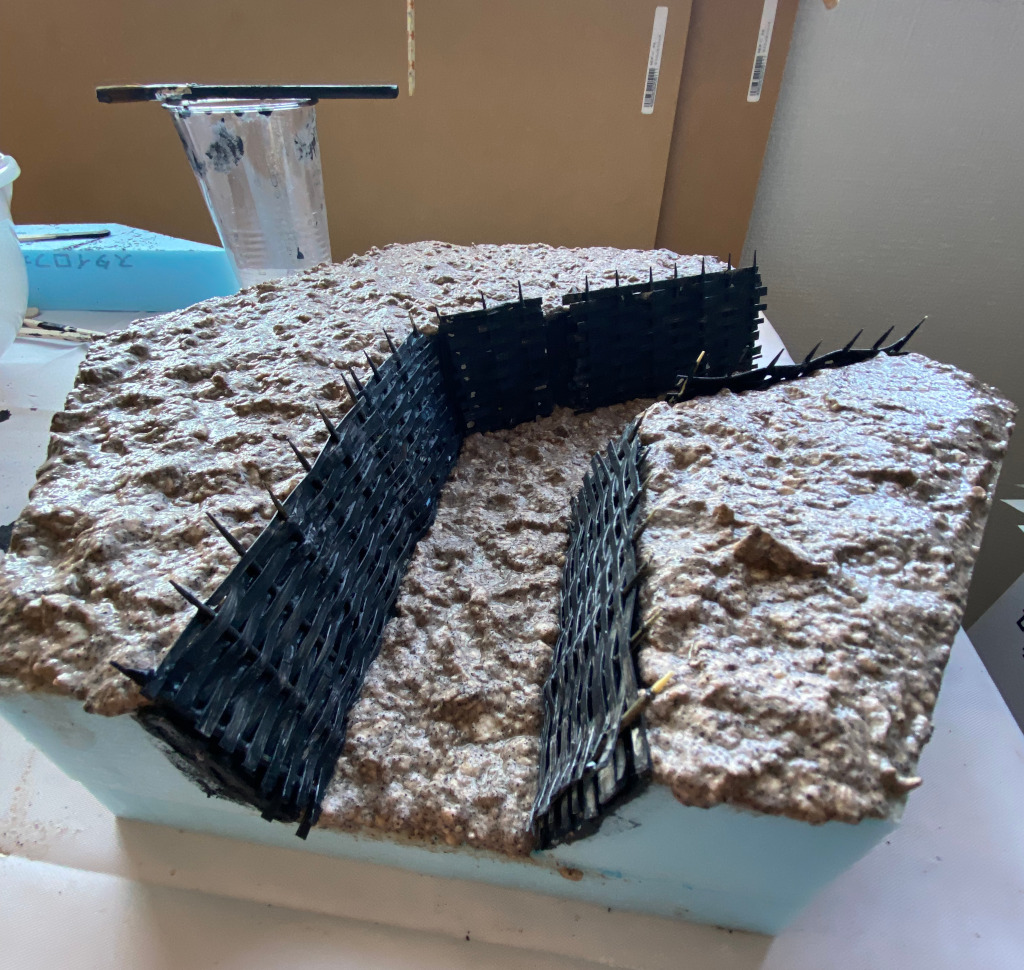
For the sides of the trenches, I collected Amazon paper envelope, since their inner side look like corrugated metal sheet, yes, that'll require some paiting. I also tried wattle weaving, at first with slices of light cardboard slaloming toothpicks, then I replaced the cardboard with the bristles of one dollar broom.
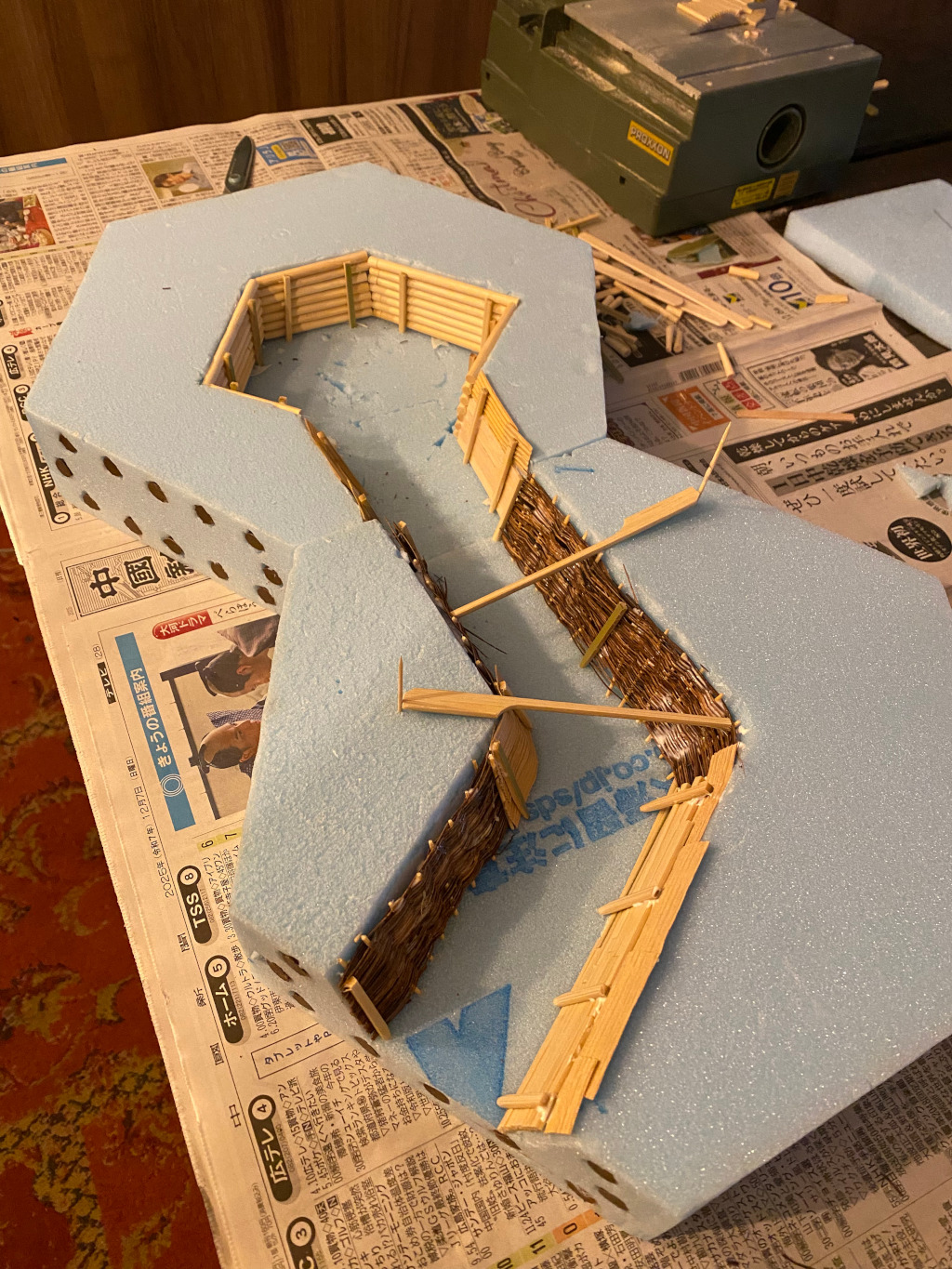
My thinking is, when trenches are first dug, there might be enough small wood for wattle fences, then local supply ends end planks are made available, later on corrugated sheets are supplied. Each hex has different pattern. I also experimented by logs and more vertical walls. The logs are round chopsticks while the vertical poles are skewers.
I cut the Amazon envelope paper in 47 x 13 mm sheets, a lot of them, and progressed by this 47 mm width to panel the trenches. I went with corrugated on top and planks at the bottom. The planks are made of ice cream sticks cut loosely in half, for a pleasing irregularity.
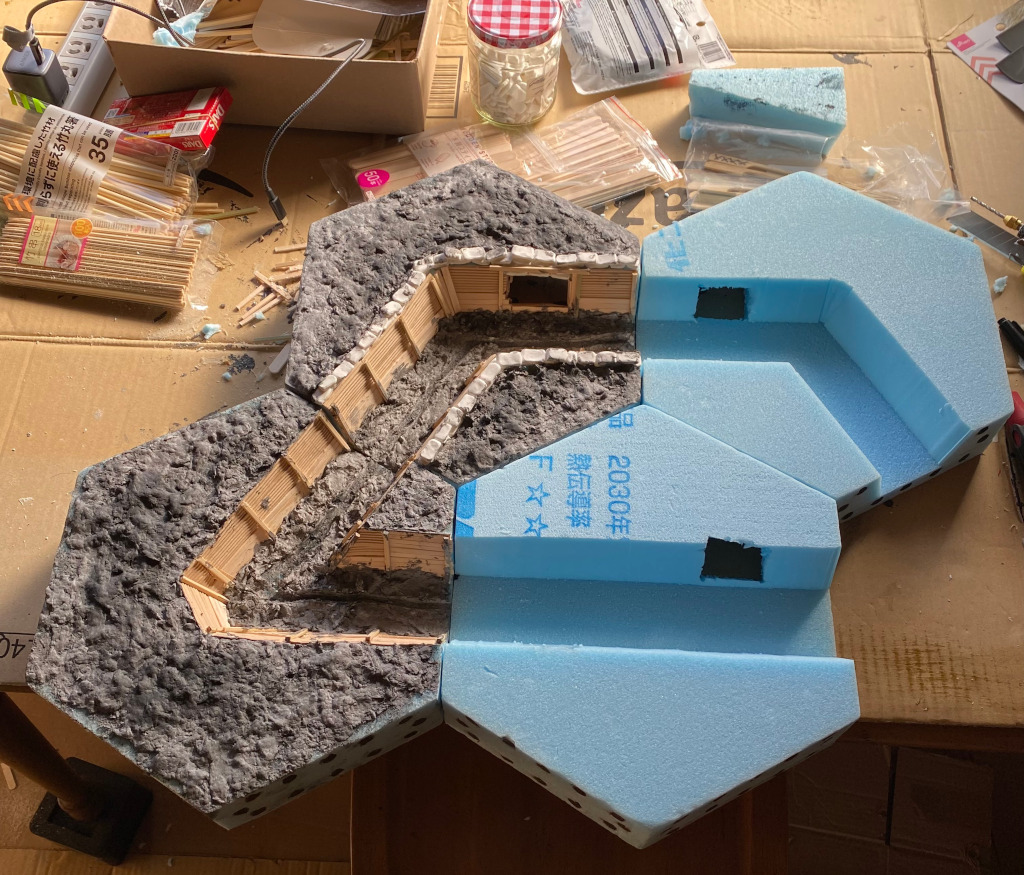
For the plain hexagons I went with caulking primer directly. For the trench hexagons, I added a layer of Sculptamold tinted with calligraphy ink for the mud. I added a central drain in the middle of the trench, I'll try some AK Puddles in the drain.
I made a lot of sandbags out of air drying clay, they look okay. I tried glueing some of them on one of the trench hexes I prepared and primed it all, but my current plan is to add the sandbags on top of the trenches afterwards.
Firesteps are currently missing. They will be modular as well, depending on the facing of the trench, and to get communication trenches simply abstain from setting up firesteps in them. The trench at the bottom have a 5 cm width, I'll give 1.6 cm width to the firestep and the rest (2.5 cm) will be for the duckboard.
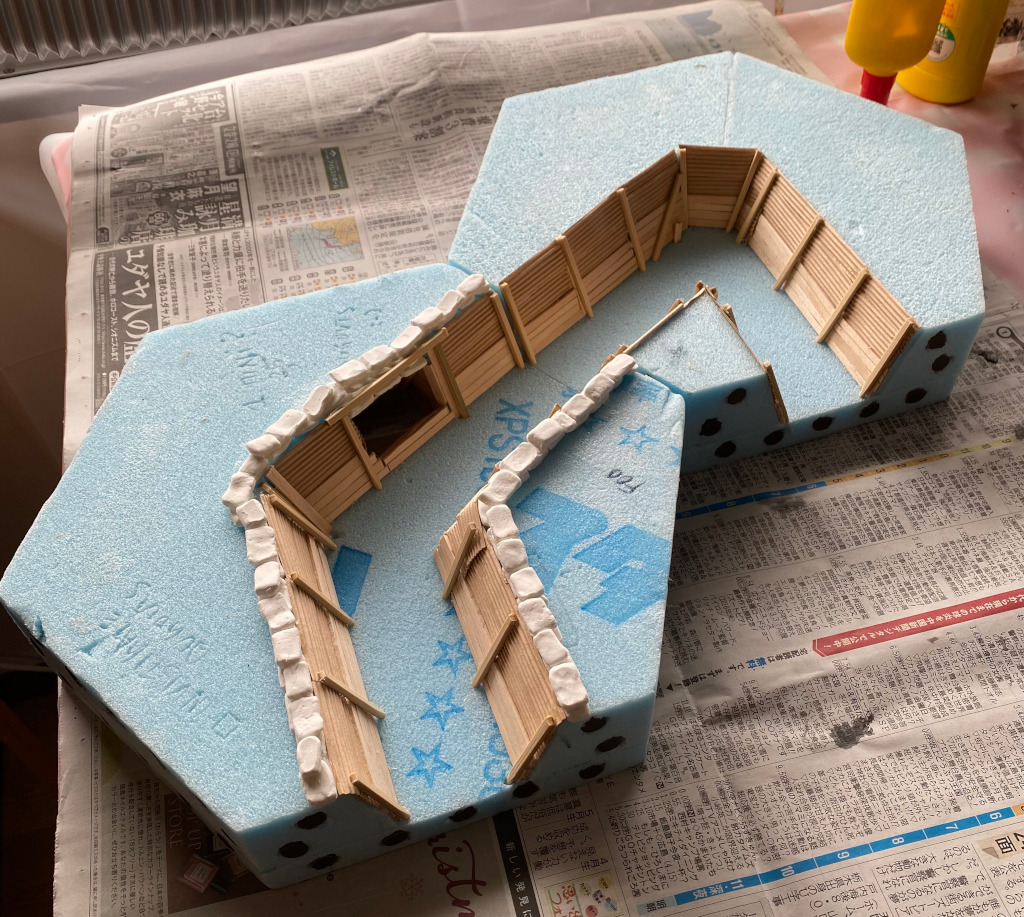
(Trench+Crusade demands that for a miniature to stand on an element, half of its base must be supported by that element, so a 1.6 cm wide firestep should be okay for 25 mm and 32 mm based miniatures)
On the last picture, dugouts are visible. I made them big enough for standing 25mm base miniatures. They are a bit too deep, but well, I don't want to ask my friends to provide standing and crouched versions of each of their 25mm based miniatures... We'll see.
I made a single trench hexagon with a straight trench, I made two non-facing dugouts in it, a bit more blast-safe somehow.
So far, I primed 11 hexagons, still 9 to go and then I'll start the painting work. I am aiming for 30 hexagons so that I have more variety for a 4x5 hex and I can go to 5x5 or even 6x5 (2 on 2 matches maybe).
I have already prepared three Nissen huts, printing their vertical walls with my fdm printer along with their curved roofs, and pasting Amazon corrugated paper on them. They look good, but that'll probably be for non-trench tables.
I am a bit in awe of the paint work that is facing me. It should be okay, I will make a mess of one or two hexagons and hope to succeed with the third one. It's all modular, and with jigs and technique I can now easily prepare new hexagons. I'll have a few ugly ducks for now, but that won't damp the excitement of the fight.
Learning by doing.