|
Firing Ports |
| 2026-01-06 |
Firing Ports
Firing ports, loopholes, embrasures...

On some of the WW1 trench pictures I consulted, I saw firing ports in sandbag walls in the form of wooden boxes. That was easy to design for 3d printing and I integrated those loopholes on top of two of the trench hexes I made.
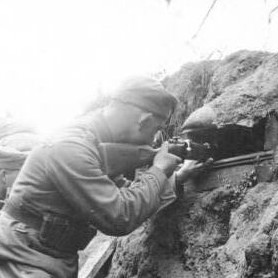
The German picture on the right sports one of those "boxes". My build lacks a bit of flat space for laying one's elbow when shooting. It seems the picture lacks it too, the Hussar in the picture has his two elbows floating.
The picture is dated 1916, the soldiers aren't wearing helmets. That made me look at the M1916 Stahlhelm that was introduced, well, in 1916. The soldiers are light cavalry — 11th Reserve Hussar Regiment — probably infantry units were given the priority in the distribution, or they were just posing for a staged picture as they were resting in a rear trench. The vegetation on the top of the trench looks well-preserved.
The picture below also shows the application of Sculptamold (tinted with calligraphy ink) to represent mud. I placed too much of the admixture in the mixer and it failed to break it, hence the big clumps one sees on the western side. The eastern side is alright, I poked holes with my fingers in it to make small craters.
I went for wattle fences with corrugated metal sheets at their feet. So far I had used Amazon envelopes corrugated paper and it looks fine. I had tried a toothpaste squeezer with thicker aluminium but was not happy with the scale. I finally ended up using some of the output in this trench hex. I think it looks okay.
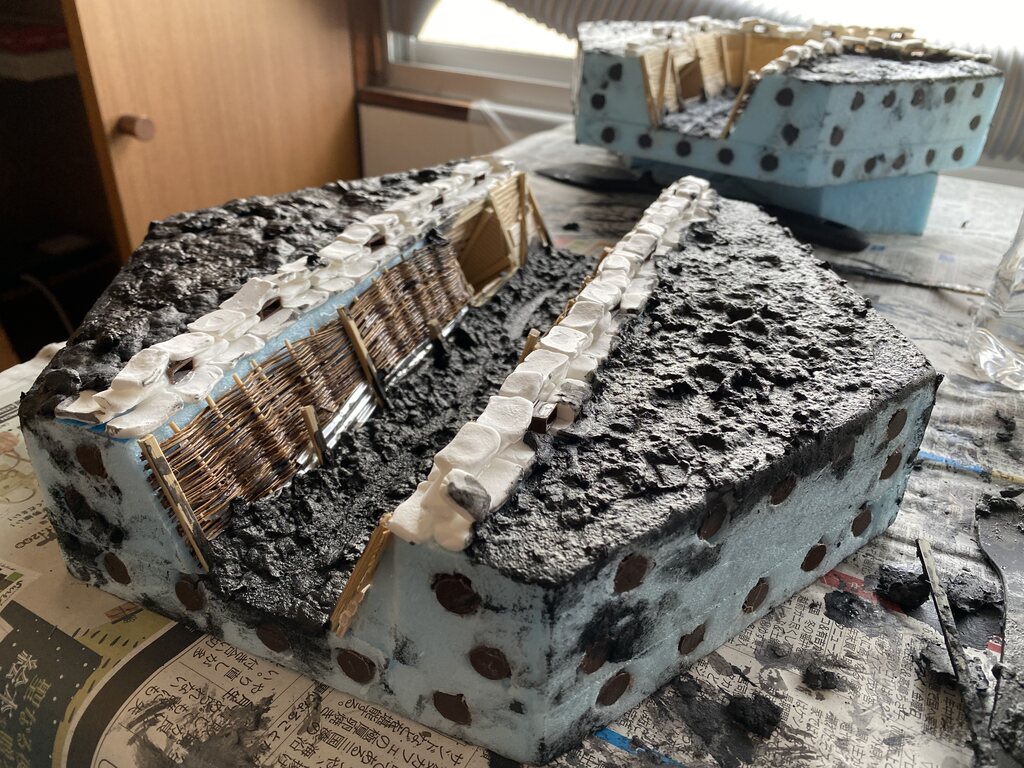
The picture is from before locking and priming with caulking latex. The magnets in their PLA boxes stand out in their lodgings in the XPS foam. I used a hand drill to prepare these nests and I filled them with PVA glue before inserting the magnet boxes.
I always trace a runoff drain in the middle of the bottom of the trench. I hope it will turn out right when covered with duckboards, I'll manage some space between the wooden slats so that the drain is visible. I still have to make those boards, along with firesteps.
Note the firestep in the picture above, it's literally a bench. It makes me even more suspicious that it's a photograph staged in a former trench.
Still five hexagons to go before reaching twenty hexagons, then four half hexagons and I'll have four feet by four feet of terrain... to paint. Well more since the non-trench hexes are usable on both sides.