|
La Main Coupée |
| 2026-03-07 |
La Main Coupée
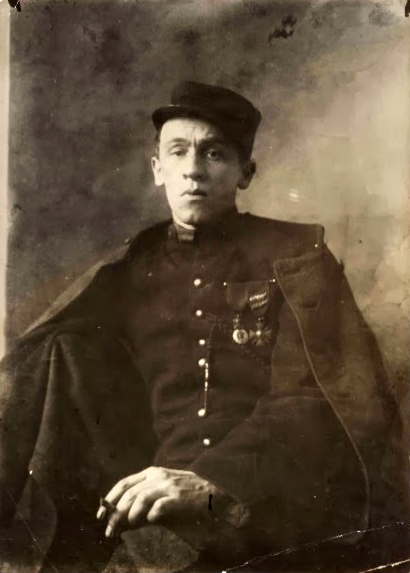
God is absent from battlefields and the dead from the beginning of the war, those poor little rookies in garance-red trousers forgotten in the grass, dotted the pasture in stains as numerous but not as consequent as cow pies.
My first read of "La Main Coupée" (the severed hand) was a little bit more than thirty years ago. Between pages, at the back of the book, I found my marching order for my first troop service in 1996, so maybe it is thirty years ago.
My French teacher was and is probably still fond of Blaise Cendrars. His dream was to come across a copy of "La Prose du Transsibérien" illustrated by Sonia Delauney.
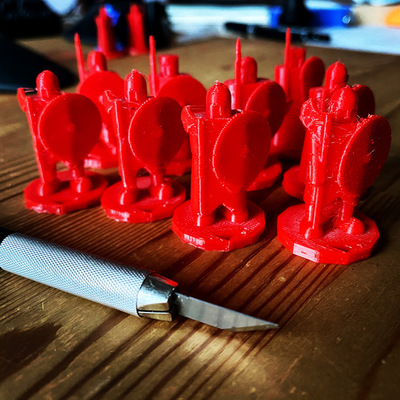
Incidentally, I played a record of this transsiberian the other evening while setting up the table for the Fellowship of the Ring. Could have Cendrars and Tolkien met under the vast sky of Northern France? There is no mention of Cendrars' foreign volunteer bataillon ever meeting British regulars.
What made me appreciate Cendrars and look for his poems and his prose is "Les Pâques à New York" (Easter in New York). Reading it felt like dancing, slowly. Is the God described there the God in Tolkien's faith?
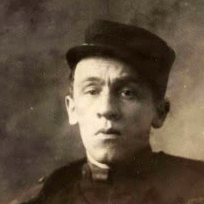
"Blaise Cendrars" is a pen name, it is a pun name, it twists to "Ember Ashes". But Cendrars did join the volunteers in 1914 under another name (his real name?). "La Main Coupée" is one of the two books that describe his trench life.
He was at first in a foreign volunteer bataillon which was later incorporated in the Foreign Legion. It is noteworthy that the Legion keeps as a sacred relic the prosthetic hand of Capitaine Danjou. Cendrars lost his right hand, while Danjou had lost his left hand.
Cendrars' trench life comes as a mosaic of people and places, anecdotes, fights against sergeants. He seems to have had a natural leadership that was resented by the regular non-commissioned officers. Cendrars could speak French, English, German, and Russian, in a foreign volunteer unit that would count.
From my first read of the book, I remembered Blaise complaining about the Germans being better equipped than them, being always one step ahead. I also remembered Cendrars working and helping the snipers in his team, he writes about Bykov, a Russian volunteer that scored many hits on enemy sentries.
Most of the people met in the book die after a short or a long while. There is no over-dramatization, probably because Cendrars had already had a life full of adventures and people. Grief is not a stranger, grief is not a foreign volunteer.
He wanted to defend France against German Imperialism. He had co-signed a call to foreign artists residing in France and cherishing it to join the the fight. Fight he did, and, after having lost his hand and being discharged, he was granted French nationality in 1916.
During the Second World War, witnessing a column of German progressing through Provence, his heart felt a pang of hope as that place was not far from where Marius had defeated the Teutons.